Hilary Shames
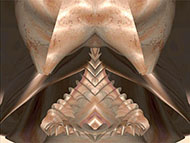 |
Shiva, 2001 virtual sculpture rendering |
Object ? of ?
Literary Quote
Shiva
On the white summit of eternity
A single Soul of bare infinities,
Guarded he keeps by a fire-screen of peace
His mystic loneliness of nude ecstasy.
But, touched by an immense delight to be,
He looks across unending depths and sees
Musing amid the inconscient silences
The Mighty Mother's dumb felicity.
Half now awake she rises to his glance;
Then, moved to circling by her heart-beats' will,
The rhythmic worlds describe that passion-dance.
Life springs in her and Mind is born; her face
She lifts to Him who is Herself, until
The Spirit leaps into the Spirit's embrace.
*
Sri Aurobindo 16-9-1939
Reference: # 102 in "Les poèmes de Sri Aurobindo" (bilingual edition)
also in "Last Poems" - 18
all published by Sri Aurobindo Ashram - Pondicherry
diffusion by SABDA
http://www.poetseers.org/themes/poems_spirituality/poems_about_shiva
I live with these myths, and they tell me this all the time. This is the problem that can be metaphorically understood as identifying with the Christ in you. The Christ in you doesn't die. The Christ in you survives death and resurrects. Or you can identify that with Shiva. I am Shiva-this is the great meditation of the yogis in the Himalayas...Heaven and hell are within us, and all the gods are within us. This is the great realization of the Upanishads of India in the ninth century B.C. All the gods, all the heavens, all the worlds, are within us. They are magnified dreams, and dreams are manifestations in image form of the energies of the body in conflict with each other. That is what myth is. Myth is a manifestation in symbolic images, in metaphorical images, of the energies of the organs of the body in conflict with each other.
http://www.qcc.mass.edu/pconnell/joec.html
See Hero of 1000 Faces - Acrobat
Definition
Shiva
In Hinduism, the third chief god (with Brahma and Vishnu) making up the Trimurti. As Mahadeva (great lord), he is the creator, symbolized by the phallic lingam, who restores what as Mahakala he destroys. He is often sculpted as Nataraja, performing his fruitful cosmic dance.
His consort or shakti (female principle) is Parvati, otherwise known as Kali or Durga.
Shiva is portrayed in a variety of ways by different Hindu sects and worshippers. To some Hindus he is the destroyer of evil; to others he is the creator, preserver, and destroyer. He is depicted with the River Ganges flowing through his hair. Tradition tells how the Ganges used to flow in heaven but was needed on earth; the river knew that her fall to earth might destroy her, so Shiva broke her fall through his hair. The crescent moon in his hair shows his creative nature.
As Nataraja, ‘Lord of the Dance’, he contains and expresses the cosmic energy of the universe, and dances the world into existence and destruction. In this form his hair falls loose, symbolizing his power. He holds a drum on which he beats out the rhythm of creation, and is surrounded by a circle of fire, symbolizing destruction. The upright hand is in the mudra (hand gesture) of protection, and he stamps on the demon of ignorance. He is worshipped before Indian classical dance performances in recognition of the divine element in all the arts.
Shiva's vehicle is Nandi, the bull, a symbol of male strength and fertility. Shiva wears snakes coiled round his arms and neck, showing his power over deadly animals and, by extension, over life and death. He is also portrayed as a meditating figure holding a trident that symbolizes his three aspects of creator, preserver, and destroyer. These three aspects are also denoted by three horizontal lines on his forehead, also worn by Shaivites (followers of Shiva).
In temples dedicated to Shiva, he is worshipped in the form of a lingam, a cylindrical phallic shape rising out of a horizontal base, the yoni. These two forms symbolize the male and female aspects of god, out of whose unity the world is created.
http://encyclopedia.farlex.com/Shiva
pitcher plant, any of several insectivorous plants with leaves adapted for trapping insects. Each leaf forms a "pitcher," a somewhat trumpet-shaped enclosure, usually containing a liquid. An insect that enters, lured by nectar and sometimes by brilliant coloration, is prevented from retreating by deflexed bristles and ultimately is drowned in the fluid. The trapped insects are apparently digested by plant enzymes and perhaps by bacteria present in the collected rainwater solution. There are three families of pitcher plants. The American family (the Sarraceniaceae) comprises three genera of bog plants, Sarracenia of E North America, Darlingtonia of N California and adjacent Oregon (the single species is D. californica), and Heliamphora of N South America. The common pitcher plant, or side-saddle flower (S. purpurea), is found in bogs from Labrador to Florida and Iowa. The Nepenthaceae, an Old World tropical family, ranging from China to Australia and Pacifica and found chiefly in Borneo, consists of the single genus Nepenthes. Many of its species and hybrids, sometimes also called monkey cups, are cultivated as novelties for their large and showy pendent pitchers. The Australian pitcher plant (Cephalotus follicularis) is the single species of the family Cephalotaceae. The bottom leaves of its low rosette are modified into brightly colored, slipper-shaped receptacles with lids and teeth. Other insectivorous plants include the bladderwort bladderwort (blăd`ərwûrt', –wôrt'), any plant of the genus Utricularia,
..... Click the link for more information. , butterwort, Venus's-flytrap Venus's-flytrap, insectivorous or carnivorous bog plant (Dionaea muscipula) native to the Carolina savannas and now widely cultivated as a novelty. The leaves, borne in a low rosette, resemble bear traps.
..... Click the link for more information. , and sundew.
The Columbia Electronic Encyclopedia® Copyright © 2007, Columbia University Press. Licensed from Columbia University Press. All rights reserved. www.cc.columbia.edu/cu/cup/
pitcher plant
Enlarge picture
Yellow pitcher plant (Sarracenia flava).
(credit: Jeff Lepore/Photo Reseachers)
Any carnivorous plant with pitcher-, trumpet-, or urn-shaped leaves. Several families include pitcher plants: Nepenthaceae (Old World pitcher plants), Cephalotaceae, Asclepiadaceae (milkweed family), and especially Sarraceniaceae (New World pitcher plants, particularly those in the eastern North American genus Sarracenia). Pitcher plants inhabit bogs, swamps, wet or sandy meadows, or savannas where the soils are water-saturated, acidic, and deficient in nitrates or phosphates. Their unusual tubular leaves have a series of nectar-secreting glands that extend from the lip down into the interior and attract insects. Once in the plant, the prey tumbles down into a liquid pool and drowns, after which an enzyme secreted within the leaf digests it, releasing nitrates and other nutrients, which supplement the meager nutrient supply of bogs. Most pitcher plants produce pitcher-shaped, insect-catching leaves in the spring and tubeless leaves in the fall. Their flowers are showy and have an agreeable scent.
For more information on pitcher plant, visit Britannica.com. Britannica Concise Encyclopedia. Copyright © 1994-2008 Encyclopædia Britannica, Inc.
pitcher plant
any of various insectivorous plants of the genera Sarracenia, Darlingtonia, Nepenthes, and Cephalotus, having leaves modified to form pitcher-like organs that attract and trap insects, which are then digested
http://encyclopedia2.thefreedictionary.com/pitcher+plant
Artist's Text
See
Sketches
Think About It
Read About It
Talk About It
Full Screen Image
Exhibition History
« back to gallery » continue tour